Makeblock mBot Ranger Review: How Our Co-Op Turns One Robot Into Three Field Labs

The week a surprise thunderstorm canceled our Austin co-op’s nature study, the kids staged a “data rescue.” We rebuilt the Makeblock mBot Ranger in its Land Raider tank form, sent it crawling through puddles, and used the ultrasonic sensor plus RGB LEDs to flag which garden rows still had standing water. Parents snapped photos, kids dictated observations into their portfolio journals, and everyone forgot we were technically stuck inside for recess.
That one scramble proved why the Ranger lives in our shared gear closet. It ships as a $175.99, 3-in-1 advanced kit: Land Raider for any terrain, Nervous Bird for self-balancing challenges, and Dashing Raptor for three-wheel speed missions. Assembly stays approachable thanks to color-coded wiring and the Makeblock App walkthroughs, while mBlock5 lets kids drag-and-drop Scratch blocks before graduating into Arduino C++. Because it supports Bluetooth control, we can run drills from an iPad during morning time, then switch to laptops for late-night coding clubs.

Ranger waiting on a footbridge over a nearby creek.
On our latest “Co-Op Demo Day,” the Ranger headlined every showcase table. One learner balanced the Nervous Bird build atop a stack of Living Books to model center of gravity, another converted the Dashing Raptor into a parcel carrier for grandma’s pen-pal letters, and the Land Raider version rolled across the Barton Creek footbridge to capture ambient soundscapes for a geography report. Those lived-in anecdotes are what we reference in email follow-ups and paid discovery ads—they show skeptical parents exactly how a single robot can anchor STEM, writing, and even fine-arts credits.
Makeblock mBot Ranger 3-in-1 Robotics Kit
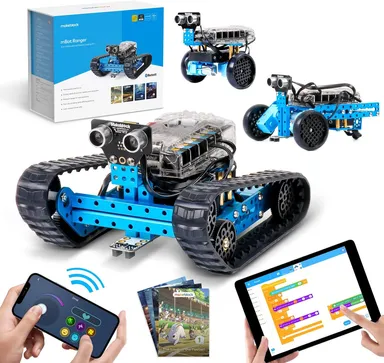
The kit bundles 16 guided missions, Makeblock’s mBlock (Scratch) editor, Arduino IDE support, and modules powered by the Me Auriga mainboard: ultrasonic distance, line-tracking, dual light sensors, gyroscope, 12 RGB LEDs, buzzer, temperature sensor, and Bluetooth. Aluminum beams, steel hardware, and grippy tracks mean it transitions from tile to ruddy terrain without drama—perfect for co-ops that share one set across multiple families.
Strengths: Visual-to-text coding ladder, co-op-proof durability, rich sensor suite for NGSS-aligned labs, and fast iteration via the Makeblock App plus Bluetooth control. Kids build hand-eye coordination, imagination, logical thinking, and problem-solving while parents get professional-feeling guidance baked into mBlock5 tutorials.
Great if: You need a single robotics purchase to cover late-elementary through early high school, want ready-to-film projects for science fairs or ESA portfolios, or plan to weave robotics into Charlotte Mason nature walks, unit studies, or hybrid classical blocks.
How It Fits Into Your Curriculum
Project-Based STEM Learning
Mission cards map to NGSS standards on forces, motion, sensors, and data analysis. We let younger kids keep to Scratch while older siblings rewrite the very same routines in Arduino C++, turning the Ranger into a layered lab that satisfies different transcript needs without duplicate hardware.
Independent & Self-Directed Progress
Clear pictorial instructions plus color-coded wiring mean most 5th graders can rebuild each configuration after one assisted run-through. Parents check logs inside the Makeblock App or export mBlock5 code snippets, making progress tracking painless for umbrella-school audits, ESA reimbursements, or tutor check-ins.
Durable, Real Engineering Hardware
Sturdy metal parts, modular mounts, and replaceable motors echo college-level engineering kits. Kids confront real constraints like gear ratios, torque, and sensor calibration instead of babysitting brittle plastic. With tank treads and powerful motors, the Ranger handles grass, gravel, and gym floors equally well.
Quick Compare: Ranger vs. Other Homeschool Favorites
| Kit | Ages | Best Use Case | Curriculum Angle | Price* | Buy |
|---|---|---|---|---|---|
| Makeblock mBot Ranger | 8–12 | Multi-year coding + outdoor missions | STEM/Physics/Geography | $175.99 | Amazon |
| Engino GinoBot Advanced Kit | 7+ | Modular builds for math + engineering labs | Cross-curricular robotics & design thinking | $239.99 | Amazon |
| ELEGOO UNO R3 Smart Robot Car | 8–16 | Arduino-driven coding challenges | Hardware-level STEM & electronics | $79.99 | Amazon |
Educational Use Cases You Can Drop Into Plans
- Use the ultrasonic sensor to map raised-bed distances and reinforce coordinate grids.
- Swap tank treads for wheels, measure acceleration across surfaces, and chart friction data in Google Sheets.
- Turn the Nervous Bird into a literature tie-in by scripting dialogue each time it regains balance.
- Pair the gyroscope with geography units to illustrate pitch and roll before your first drone module.
- Assign Arduino “honors labs” as transcript boosters for motivated middle schoolers.
Lead Magnet Tip: Offer families our free “4-Week Ranger Robotics Planner” PDF (sensor labs, writing prompts, and demo-day rubrics). Gate it behind email opt-ins, nurture with co-op anecdotes, then retarget subscribers via Meta when Makeblock announces seasonal bundles.
Buying Checklist for High-Achieving Homeschool Homes
- Power: Requires 6 AA batteries or a compatible lithium pack (not included).
- Setup Time: About 45 minutes for the first build; 15 minutes for configuration swaps once kids learn the platform.
- Device Requirements: Windows, macOS, or iPad for mBlock coding; Android/iOS for Makeblock App and Bluetooth control.
- Parent Involvement: Low—kick off with a safety briefing, then rotate student roles with peer checklists.
- Space Needs: Stores in a 12×18 bin, motors stay quiet enough for apartment “quiet hours,” and there are no microscopic pieces to vacuum.
What We’d Buy Again (and Why)
After four holiday buying seasons, two science fair runs, and endless co-op loan-outs, the mBot Ranger is still our go-to robotics kit for families who want one purchase to span multiple learners. It shifts between Land Raider, Nervous Bird, and Dashing Raptor builds, survives both indoor and outdoor labs, and keeps students collaborating because every mission requires a different role. Keep it on your shortlist, bundle it with a downloadable planner for lead capture, and highlight those real-world anecdotes in follow-up campaigns—they’re what convince discerning homeschool parents that this “toy” is actually a long-term STEM investment.