The $499 Gaggia Classic Pro That Quietly Replaced Our $8,000-a-Year Coffee Habit

The moment we realized we’d become “High Earners, Not Rich Yet” caricatures was a random Tuesday in January. My wife texted me a screenshot of our credit card statement: four different coffee shops in three days, all within a mile of our condo. Between her oat-milk lattes, my double shots, and the emergency cold brews on daycare pickup days, we were quietly burning through several thousand dollars a year on coffee we barely had time to enjoy.
That night we ran the math on the couch, still buzzing from $7 cortados, and set a rule: if we were going to keep acting like people who live in coffee shops, we at least needed a home setup that made the math less stupid. Enter the Gaggia RI9380/46 Classic Pro (E24) Espresso Machine—a compact, made-in-Italy, semi-automatic machine with a real 58 mm commercial portafilter, 9-bar extractions, a 2.1 L tank, and a legit steam wand that doesn’t feel like a toy. It took over the corner of our kitchen and quietly replaced our “swing by the cafe” reflex with a 10-minute morning ritual that actually feels like a luxury, not a scramble.
Two things hooked us immediately:
- The build: solid steel housing, chunky rocker switches, and a commercial three-way solenoid valve that leaves a dry puck instead of “espresso soup” in the portafilter.
- The workflow: you grind (we use a separate burr grinder), lock in the 58 mm portafilter, hit the brew switch, and the Gaggia’s 9-bar pump and updated internals just do their job—no apps, no Bluetooth, no “cloud-connected” nonsense.
Within a couple of weeks, the Gaggia had eaten our weekday cafe habit. Saturday mornings turned into latte-art attempts with the commercial steam wand, and we started inviting friends over for “espresso flights” before dinners instead of meeting at a crowded shop. For a box that costs less than one month of our old coffee run rate, it has paid for itself embarrassingly fast.
Gaggia RI9380/46 Classic Pro (E24) Espresso Machine
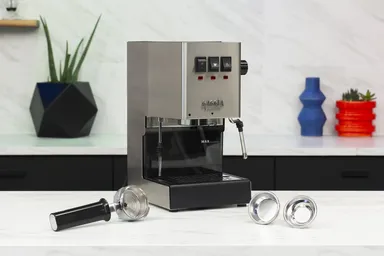
The Gaggia RI9380/46 Classic Pro (often referred to as the current “E24” revision) is a compact, Italian-made, semi-automatic machine built around 9-bar espresso extractions, a stainless-steel 58 mm commercial portafilter, and a commercial three-way solenoid valve that gives you clean, dry pucks instead of soggy grinds to scoop out of the basket. Behind the steel shell you get a 2.1 L water tank, around 1200 W of power, and a layout designed so a reasonably handy person can descale, swap gaskets, and keep it running for years instead of treat it like a disposable appliance.
The star feature for HENRY households is the commercial steam wand. Unlike the “froth wands” on entry-level machines, this wand can actually produce silky microfoam for flat whites and lattes, not just giant soap bubbles. That means cafe-level drinks at home once you get the hang of milk texturing—and you do, quickly, because the wand responds like the gear you see in real coffee shops.
- Built to last: solid steel housing, made in Italy, with commercial-style grouphead and portafilter parts you can actually replace.
- Real espresso workflow: 9-bar extractions through a 58 mm basket, 3-way solenoid for clean pucks, and classic rocker switches for brew, steam, and power.
- Legit milk drinks: commercial steam wand powerful enough for latte-art microfoam, not just warmed milk.
- Upgrade-friendly: supports common mods (PID kits, bottomless portafilters, precision baskets) if your inner coffee nerd wakes up in a year.
Great if: you want to stop spending condo-rent money on “quick” coffee runs, care more about reliable, repeatable shots than touchscreens, and like the idea of a machine that feels at home in a real barista workflow. It’s ideal for HENRY couples who can afford the Breville-and-beyond tier, but prefer a compact, bombproof, classic machine that still leaves room in the budget for a serious grinder.
How the Gaggia Fits Into a HENRY Week
Monday–Friday: Replace the Commuter Latte Run
Our pre-Gaggia mornings were a mess: one of us sprinting to a cafe after daycare drop-off, the other rage-refreshing a mobile order that always seemed to be “just one more minute” out. Now the sequence is boring—in the best way:
- Wake the machine before showering so the boiler and grouphead come to temperature.
- Grind into the 58 mm basket, level and tamp.
- Hit the brew rocker, watch for the thick, honey-like stream and crema.
- Steam milk while the other person packs lunches.
By the time we’re arguing over who’s handling school spirit week, two lattes and a straight espresso are sitting on the counter—and nobody has had to put on real pants yet.
Evenings: “We Have People Over Now, Apparently”
Hosting used to mean grabbing a bottle of wine and hoping our friends didn’t suggest another round of $18 cocktails. With the Gaggia, dessert at our place became the default:
- Pull a couple of double shots back-to-back with the 2.1 L tank barely budging.
- Steam a pitcher of milk for cappuccinos and flat whites.
- Use the dry pucks and quick cleanup to keep the conversation going instead of disappearing into the kitchen for 15 minutes.
We’ve even started a low-key ritual: whoever nails the best latte art that night doesn’t have to load the dishwasher. The commercial steam wand makes it surprisingly fair.
Weekends: Mini Coffee Lab, Without the Tech Overload
The Gaggia doesn’t have built-in grind settings, an app, or programmable profiles—and that’s the point. You set grind, dose, and time yourself. That’s catnip for the type of HENRY who tracks their investments in spreadsheets and secretly loves variables:
- Try different beans from local roasters without feeling locked to a “house blend” profile.
- Time your shots and tweak grind size until you can consistently land in that 25–30 second sweet spot.
- Practice latte art with the commercial wand while your kids draw faces on your more abstract attempts.
Quick Compare: Gaggia vs. Breville vs. Ninja Luxe Café
If you’re a HENRY household deciding where to drop $500–$700 on coffee gear, the choice is really about workflow and how much you want the machine to think for you.
| Machine | Grinder | Drinks It Makes Best | Who It’s For | Price* | Buy |
|---|---|---|---|---|---|
| Gaggia RI9380/46 Classic Pro (E24) | Separate grinder required (58 mm commercial portafilter, 9-bar extractions) | Straight espresso, Americanos, classic cappuccinos and lattes via commercial steam wand | You want a compact, made-in-Italy “real espresso” machine that feels like cafe gear and will happily serve you for a decade with basic maintenance. | $499.00 | Amazon |
| Breville Barista Express BES870XL | Built-in conical burr grinder, PID temperature control, 67 oz tank | Bean-to-cup espresso and milk drinks with fewer separate boxes on the counter | You want an all-in-one unit with integrated grinder, digital temp control, and a very polished out-of-the-box experience, and you have a bit more budget and counter depth. | $685.99 | Amazon |
| Ninja Luxe Café 3-in-1 (ES601) | Integrated grinder with Barista Assist, weight-based dosing | Espresso, drip coffee, and rapid cold brew in one machine | You care more about variety and convenience (espresso, pots of drip, iced drinks) than pure espresso nerdery and want the machine to handle more of the decision-making for you. | $599.99 | Amazon |
Buying Checklist for High-Earner Households
- Footprint & Aesthetics: The Gaggia’s 8” × 9.5” × 14.2” footprint fits on most condo counters without feeling like a commercial monster, and the brushed stainless shell actually looks good next to nicer knives and pans.
- Power & Voltage: 1200 W on standard 120 V—no special circuit required. Just don’t run the espresso machine and the hair dryer on the same tiny kitchen breaker.
- Noise & Routine: Updated pump mounting makes it less rattly than older budget machines, but it’s still an espresso pump—you’ll hear it. Our kids now treat the brew noise as the official “time to put shoes on” alarm.
- Maintenance: Plan on regular descaling, wiping the steam wand after every use, and replacing grouphead gaskets every so often. Most tasks are straightforward and well-documented, which is part of the appeal over sealed, app-first appliances.
- Upgrade Path: Because it uses standard 58 mm commercial dimensions, you can add precision baskets, bottomless portafilters, or even PID kits later if you catch the bug—without replacing the whole machine.
Why We’d Buy the Gaggia Again
We could afford to keep our cafe habit. That’s kind of the whole HENRY problem: you can throw money at every small inconvenience and still wonder where your savings went. The Gaggia didn’t magically fix our net worth, but it did something more tangible: it turned coffee from a rushed, overpriced errand into a small daily ritual we actually notice.
We still meet friends at third-wave spots when it makes sense—but the default is now our kitchen, our beans, and a machine that earns its spot on the counter every single day. If you’re staring at your own statement full of mobile orders and “quick stops,” the Gaggia Classic Pro is the point where the math, the experience, and the gear finally line up.